Optical and Electronic Properties of Epitaxial Germanium
Optical characterization, modeling, and strain-dependent transitions in epitaxial Ge and GeSn thin films.
Overview
This research examines the
- optical and electronic behavior of epitaxial Ge and GeSn thin films for photonics and quantum devices, using spectroscopic ellipsometry, and critical-point (CP) analysis.
- How strain, defects, buffer layer thickness, and substrate orientation modulate the dielectric response and band-structure transitions.
1️⃣ Optical Constants and Critical-Point Transitions in Biaxially Tensile-Strained Ge
Phys. Rev. Applied 23, 024037 (2025)
DOI: 10.1103/PhysRevApplied.23.024037
- Comprehensive ellipsometry modeling of biaxially strained epitaxial Ge films grown by molecular beam epitaxay (MBE).
- Strain-induced shifts in Critical Point transitions were extracted via second-derivative CP analysis, linking strain and film thickness to dielectric evolution.
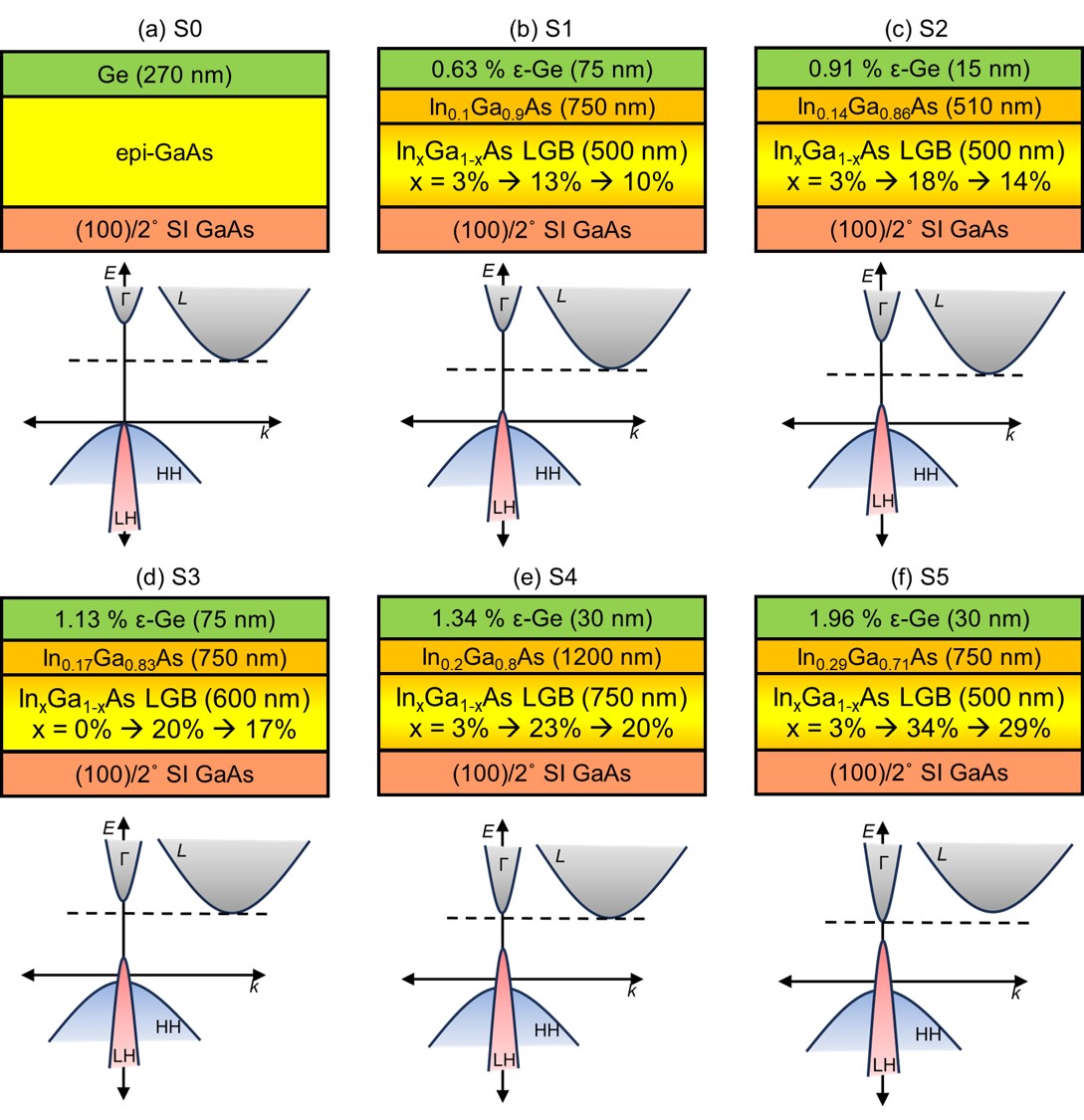
Energy band diagram alteration in strained Ge films. © American Physical Society, License RNP/25/OCT/097415.
Key Findings:
- Extracted full (n, k) and (ε₁, ε₂) spectra for strained Ge.
- Developed a multi-layer optical model including surface and oxide effects.
- Established strain–band-structure correlation for Si-compatible photonics.
Methods
- Spectroscopic Ellipsometry (0.4–4.5 eV)
- Critical-Point Analysis
Related Publications
- Optical constants and critical-point transitions in biaxially tensile-strained epitaxial thin films of germanium
Rutwik Joshi, Nina Hong, Neha Singh, Muntasir Mahdi, and Mantu K. Hudait Phys. Rev. Applied 23, 024037 (2025)
DOI: 10.1103/PhysRevApplied.23.024037 - Impact of defects, buffer layer thickness, and substrate orientation on optical properties of epitaxial germanium (Under Review) Muntasir Mahdi, Nina Hong, Neha Singh, Mantu K. Hudait