Electroplating Indium for Current-Controlled Magnon–Photon Coupling
Electroplating of indium bumps on Nb and NbN coplanar waveguides and resonators for flip-chip bonded current-controlled magnon–photon coupling measurements.
This project developed a
- Nb and NbN coplanar waveguide (CPW) platform with indium bump electroplating for flip-chip bonded, current-controlled magnon–photon coupling experiments.
- The DC lines and indium bumps enable current injection (spin pumping) across magnetic samples, allowing tunable hybrid interactions in cryogenic measurements.
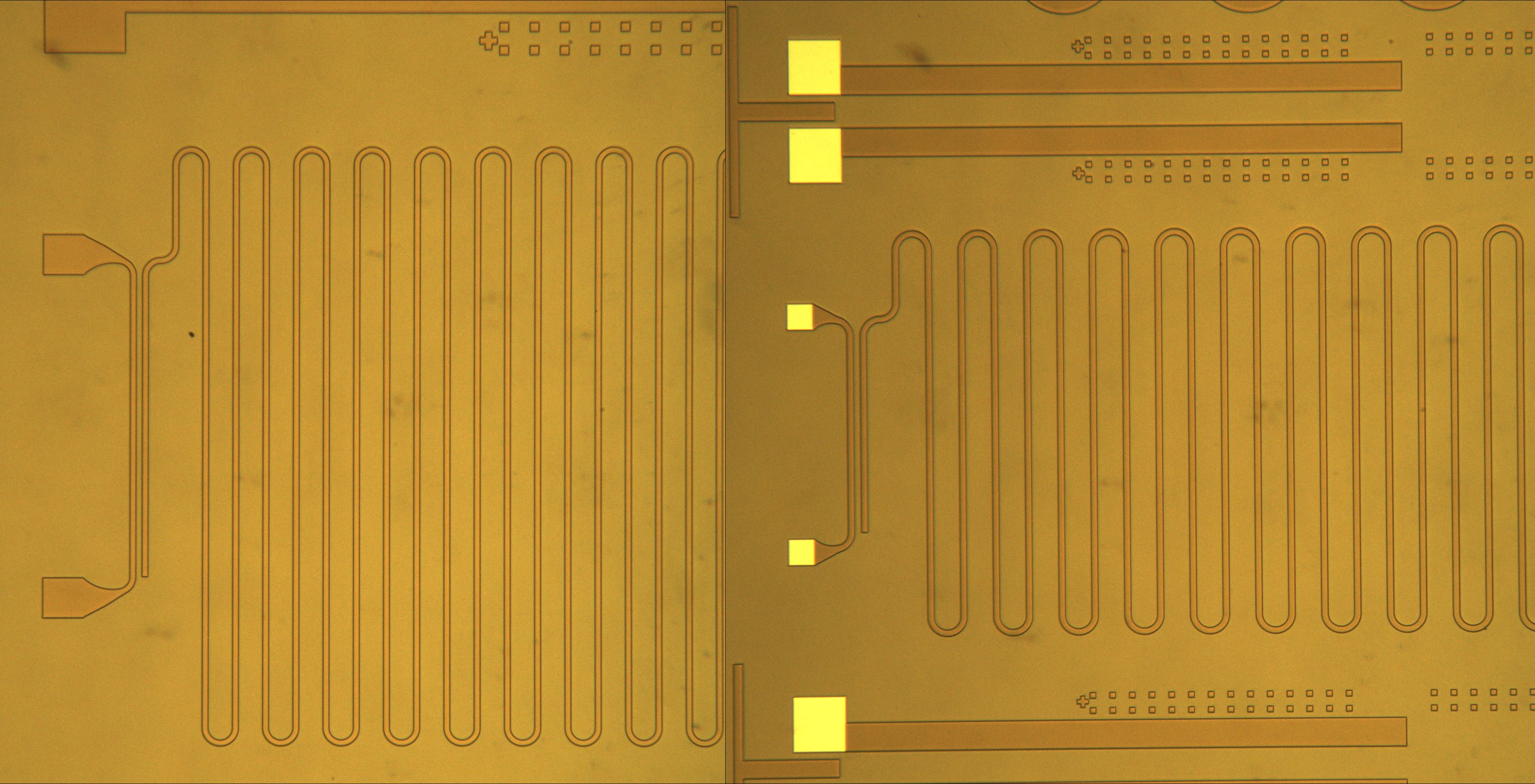
NbN resonator before (Left) and after (Right) Al contact pad deposition.
Electroplating Process
- Indium bumps were electroplated at predefined contact pads on Nb and NbN DC lines using a pulsed DC electroplating process with a Ti/Cu seed layer for conductivity and adhesion.
- Deposition parameters were optimized for uniform thickness (~10–15 µm), low roughness, and excellent mechanical stability during flip-chip alignment.
- Module used: HP Hewlett Packard 8011A Pulse Generator
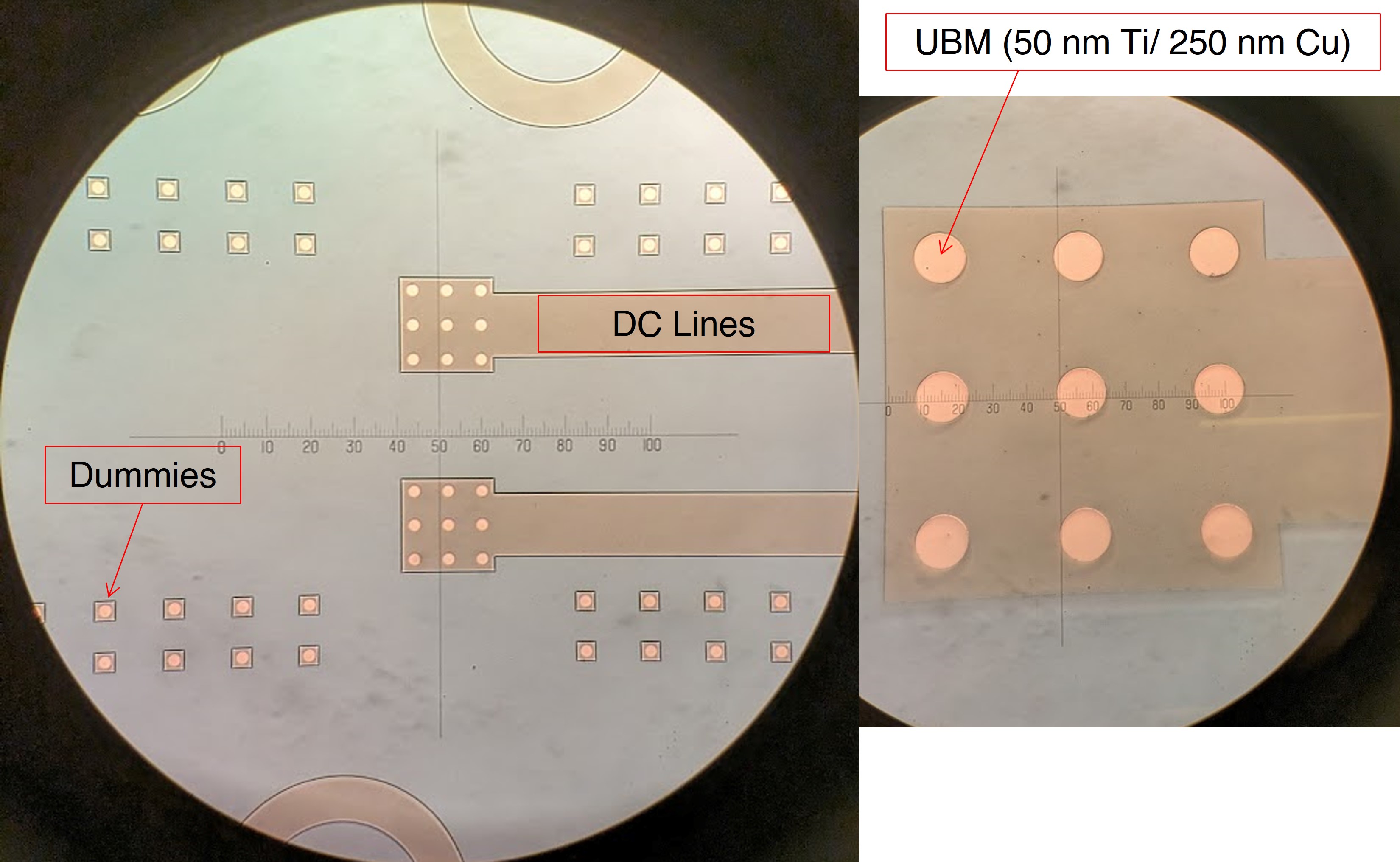
Indium electroplating setup used for depositing bumps on superconducting Nb and NbN CPWs.
Flip-Chip Integration and DC Lines
- The electroplated indium bumps were designed for flip-chip bonding with magnetic or hybrid samples containing DC bias lines for current control.
- These bonded structures enable dynamic modulation and spin pumping of the magnon–photon coupling strength by injecting DC bias through the superconducting paths.
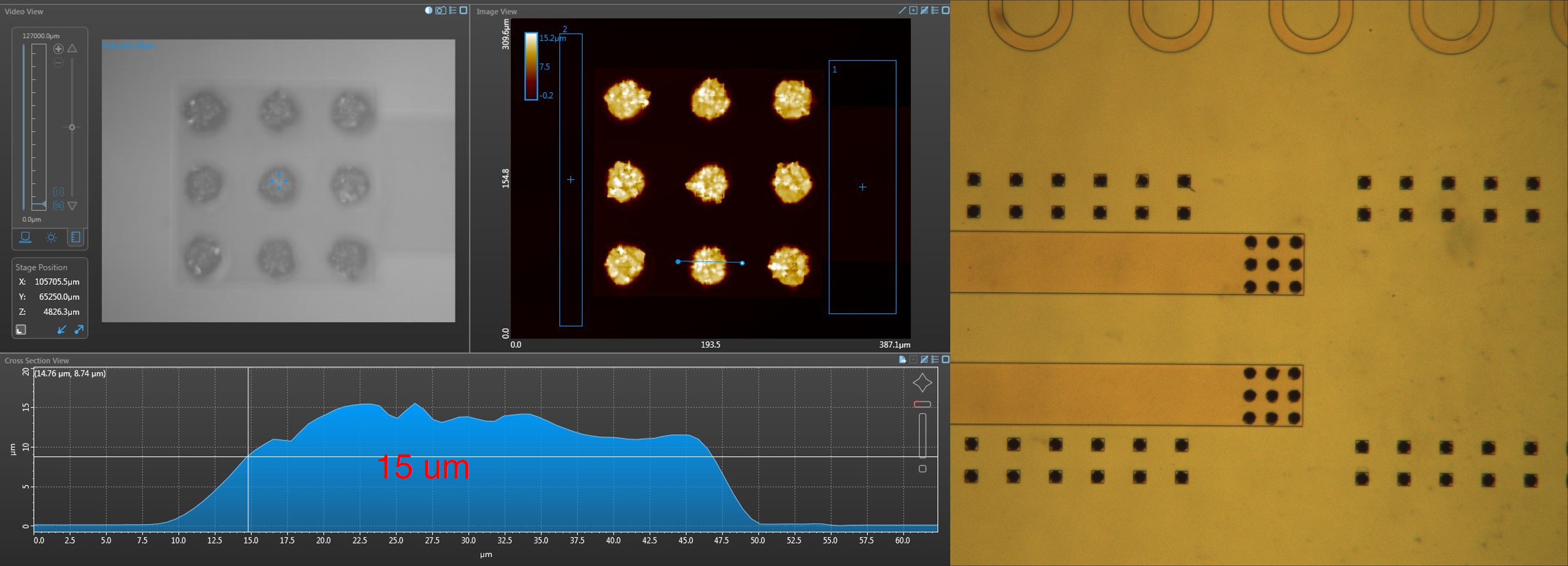
Microscope image of electroplated indium bumps on Nb CPW pads for flip-chip bonding.
Connection to Related Work
This electroplating process supports the Nb and NbN superconducting resonator, coplanar waveguides project used for magnon-magnon and magnon–photon coupling studies. Details of the resonator design and measurement setup are described on NbN Resonators.
Acknowledgment
This research is supported by the Air Force Office of Scientific Research (AFOSR) under grant funding for hybrid quantum systems.
